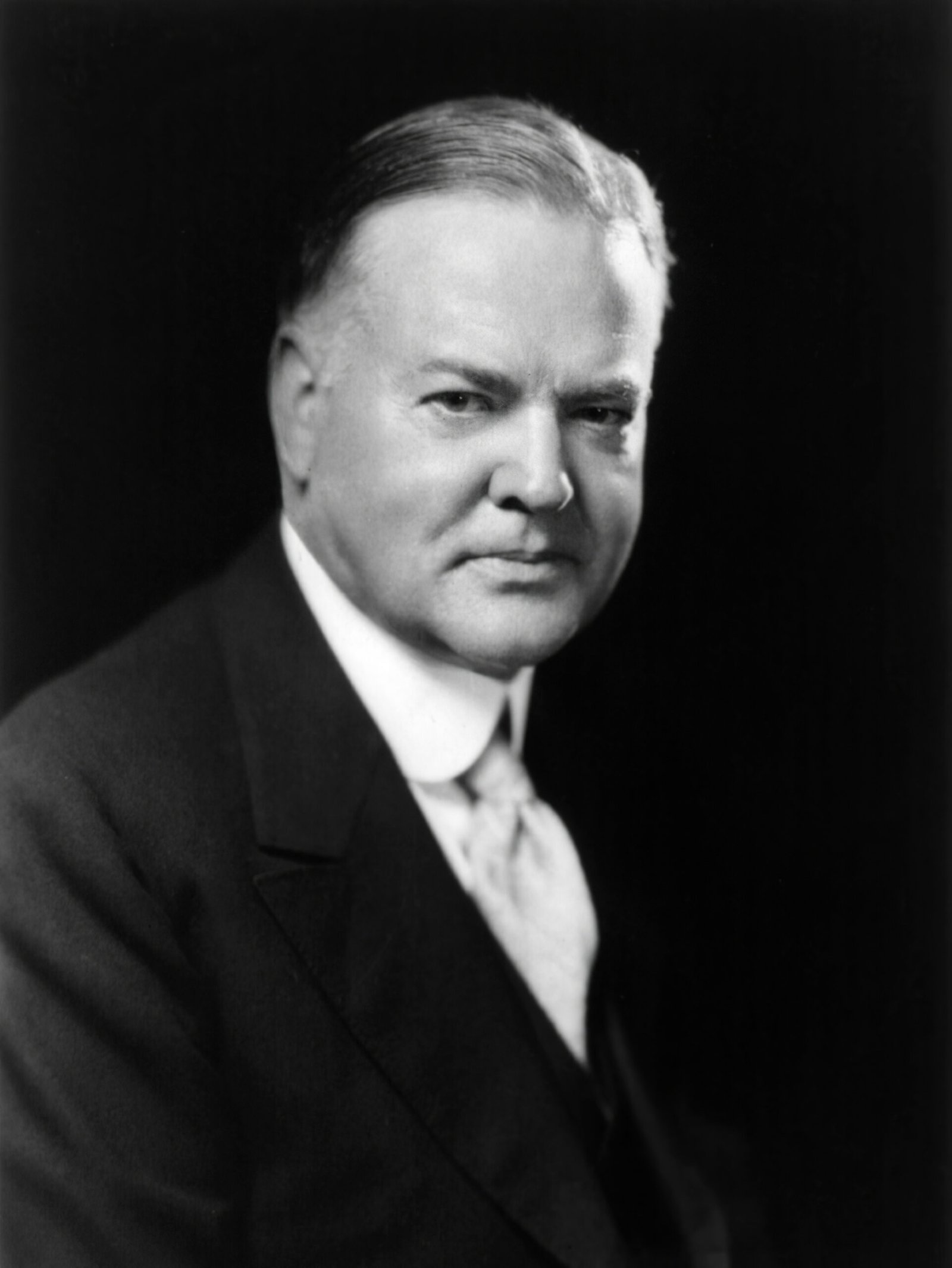
Overview and time in office
Herbert Clark Hoover served as the 31st President of the United States from March 4, 1929, to March 4, 1933. He was a Republican who took office at the end of the Roaring Twenties and left after one term following the 1932 election. whitehouse.gov
Election context and opponents
Hoover won the 1928 presidential election in a landslide over Democratic nominee Alfred E. (Al) Smith; the Republican ticket of Hoover and Charles Curtis captured 444 electoral votes to Smith’s 87 and carried a large popular-vote majority. presidency.ucsb.edu
By 1932, with the nation deep in the Great Depression, Hoover was decisively defeated by Democrat Franklin D. Roosevelt. Roosevelt won 472 electoral votes to Hoover’s 59 on November 8, 1932, inaugurating a major political realignment and the New Deal era. archives.gov
Party, vice president and principal Cabinet figures
Hoover was a Republican. His vice president for the full term was Senator Charles Curtis of Kansas. Curtis, a longtime congressional leader, was Hoover’s running mate in 1928 and served as vice president from 1929 to 1933. senate.gov
Key Cabinet officials in Hoover’s administration included Secretary of State Henry L. Stimson, Secretary of the Treasury Andrew W. Mellon (until early 1932), and Attorney General William D. Mitchell; these figures shaped foreign policy, fiscal policy, and legal responses to the nation’s crises. history.state.gov
Major domestic policies and legislation
Hoover’s domestic approach combined support for voluntary cooperation among business, state and local relief efforts, protective trade measures, and—late in his term—limited federal credit and public-works programs. He resisted large-scale direct federal welfare at first, preferring private relief and local government action. As the Depression deepened he shifted toward stronger federal intervention. millercenter.org
Important laws and programs enacted or signed during his presidency include the Tariff Act of 1930 (commonly called the Smoot–Hawley Tariff), which raised U.S. duties on many imports; the Reconstruction Finance Corporation (RFC) Act of January 22, 1932, creating a government-owned lending agency to support banks, railroads and other institutions; and the Emergency Relief and Construction Act of July 1932, which expanded federal lending for public works and relief. cfr.org
Foreign affairs
Hoover’s administration continued interwar efforts at arms limitation and diplomatic management. The United States participated in the London Naval discussions and related naval agreements around 1930. In East Asia, Secretary of State Henry Stimson articulated the policy of nonrecognition toward territories acquired by force, a response to Japan’s invasion of Manchuria often described as the “Stimson Doctrine.” These policies reflected restraints of international law rather than military action. dc-naval-history.com
In Latin America Hoover’s team emphasized reduced overt military intervention and greater economic and diplomatic engagement—an early movement toward what later came to be called a Good Neighbor approach. Policy, however, remained constrained by domestic priorities and the economic crisis. millercenter.org
National crises and the administration’s response
Hoover’s presidency was dominated by the Wall Street crash of October 1929 (“Black Tuesday,” October 29, 1929) and the Great Depression that followed. The crash did not in itself cause every economic failure, but it precipitated bank runs, collapsing credit and steep unemployment that defined Hoover’s time in office. eh.net
Other crises included the Bonus Army episode in 1932, when thousands of World War I veterans seeking early payment of a promised bonus camped in Washington, D.C.; the administration ordered their removal and the army—under General Douglas MacArthur—cleared camps in July 1932. The harsh public impression of that action damaged Hoover politically. millercenter.org
Major controversies
Historians debate several controversies from Hoover’s term. The signing of the Smoot–Hawley Tariff in June 1930 remains controversial: critics argue it worsened global trade contraction and deepened the Depression, while defenders note that tariff policy reflected strong congressional pressure and domestic political priorities. cfr.org
Another contested issue is the scale and character of “Mexican repatriation” during the early 1930s: large numbers of people of Mexican descent left or were forced out of the United States in programs and local drives whose causes and federal involvement are still studied; estimates vary and scholars emphasize that much of the activity involved state and local officials as well as private actors. The episode is widely treated today as a troubling part of Depression-era social policy. history.com
Finally, assessments of Hoover’s overall response—often summarized in the slogan that he was a “do-nothing” president—are contested. Recent scholarship and archival evidence show he pursued a mix of market-based and federal-credit responses and that some New Deal programs built on initiatives begun under Hoover; critics nonetheless charge the scale and timing of aid to ordinary unemployed Americans was insufficient. The debate continues among historians over responsibility, capacity, and ideology. en.wikipedia.org
Historical legacy
Hoover’s long post-presidential public life shaped his legacy. He criticized aspects of the New Deal, led influential postwar commissions on government organization (often called the “Hoover Commissions”), and remained an important figure in public-policy circles. Historians now see Hoover as a complex figure: a humanitarian and administrative reformer who believed in efficient government, yet constrained by conservative views about direct relief and by political limits when the Depression deepened. Scholarship emphasizes both his policy initiatives (including federal credit facilities and administrative reforms) and political failures (public perception and electoral defeat). hoover.archives.gov
Conclusion (neutral summary)
Herbert Hoover’s presidency was brief but consequential. Faced with an economic collapse of historic scope, his administration combined voluntary, regulatory, tariff, and—later—direct federal credit measures. Some of his initiatives anticipated later New Deal tools; others provoked controversy and political backlash. The balance between intent, ideology and the extraordinary economic shocks of 1929–1933 makes assessment of his record a continuing subject for careful archival and scholarly inquiry. citeseerx.ist.psu.edu
Sources
- The White House — Herbert Hoover
- Herbert Hoover Presidential Library and Museum
- National Archives — 1928 Electoral College Results
- National Archives — 1932 Electoral College Results
- Miller Center — Herbert Hoover
- Office of the Historian, U.S. Department of State — Henry L. Stimson
- U.S. Department of the Treasury — Andrew W. Mellon
- Council on Foreign Relations — Smoot–Hawley Tariff (1930)
- History.com — Bonus Army (1932)
- EH.Net Encyclopedia — The 1929 Stock Market Crash
- USCIS / INS records — 1930s Mexican Repatriations
Smart shopping starts here.
If you enjoyed this article, explore our curated products designed for everyday living.
📱 Download the Dralys App
🛍️ Shop now: www.DralysStore.com