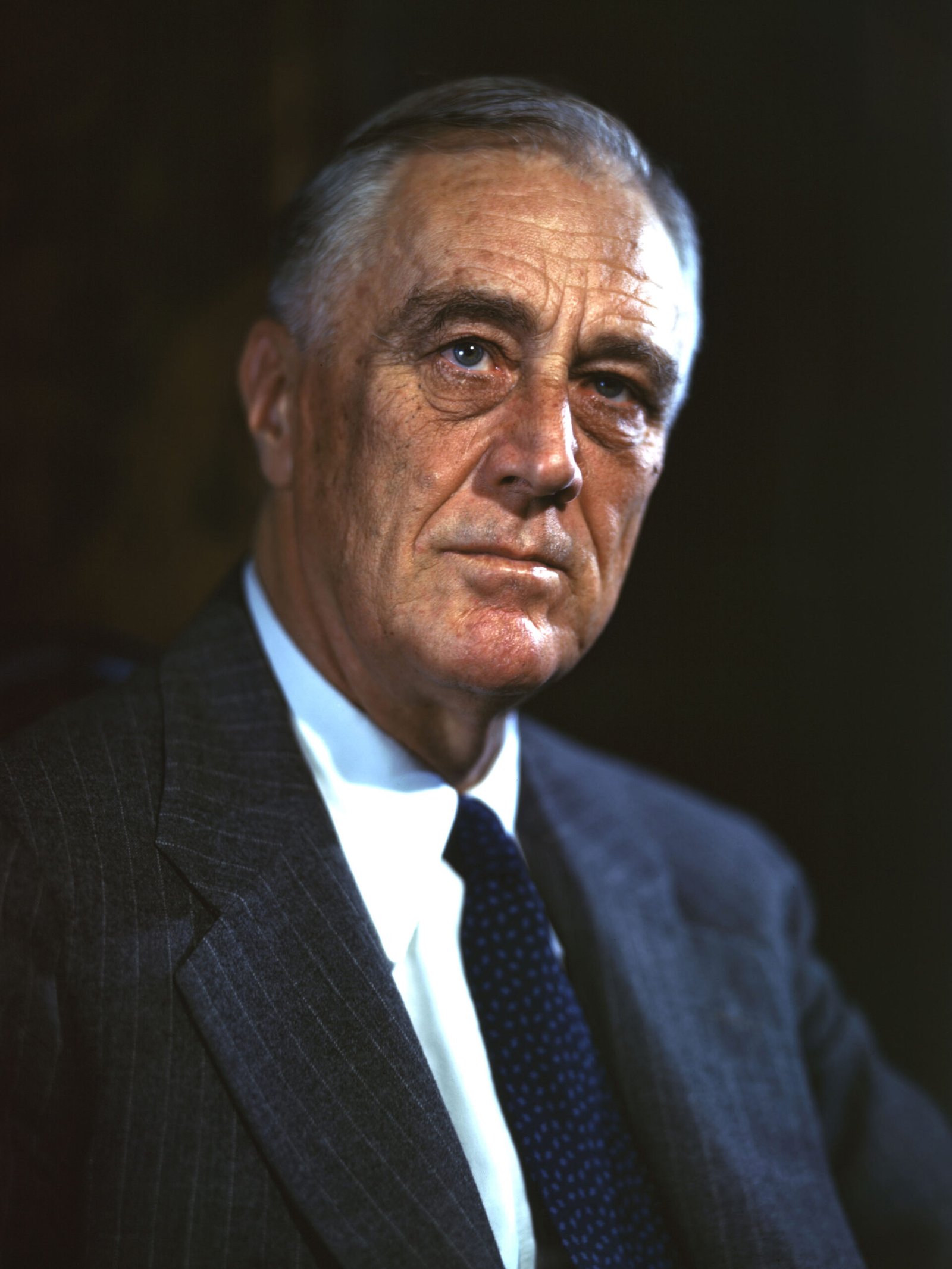
Franklin D. Roosevelt: Steering the Republic Through Depression and War
Franklin Delano Roosevelt (FDR) served as the 32nd president of the United States from March 4, 1933, until his death on April 12, 1945. A Democrat and governor of New York before the presidency, Roosevelt won national office in 1932 and was elected to an unprecedented four terms. His years in office combined an experimental domestic agenda known as the New Deal with decisive wartime leadership after 1941. fdrlibrary.org
Elections and political context
Roosevelt first won the presidency in 1932, defeating incumbent Herbert Hoover as the nation sought a response to mass unemployment and financial collapse. He won re-election in 1936 in a national landslide, carried a third term in 1940 as war spread in Europe, and secured a fourth term in 1944 while American forces were fighting abroad. Each contest reflected different national moods—economic crisis, consolidation of New Deal coalitions, and wartime continuity. archives.gov
Vice presidents and the White House team
Across his four terms Roosevelt had three vice presidents: John Nance Garner (1933–1941), Henry A. Wallace (1941–1945), and, for the beginning of his fourth term, Harry S. Truman (January–April 1945). Roosevelt’s presidential teams also included a small inner circle of advisers and several long-serving Cabinet members who shaped policy. senate.gov
Leading Cabinet and advisers
Important Cabinet figures and advisers included Secretary of State Cordell Hull, who served for most of the administration and helped prepare the postwar international order; Secretary of the Treasury Henry Morgenthau Jr., a principal economic and wartime finance official; Secretary of Labor Frances Perkins, the first woman cabinet member and an architect of social-policy work; and Harry Hopkins, a close confidant who directed relief programs and later advised on wartime policy. These officials and others combined policy design, administration and diplomacy across two national crises. history.state.gov
Major domestic policies: the New Deal
Facing the Great Depression, Roosevelt and Congress pursued an array of relief, recovery and reform measures collectively called the New Deal. Early emergency banking measures and the Banking Act of 1933 sought to stabilize finance and created federal deposit insurance; the Works Progress Administration (WPA) and related agencies provided public‑works jobs; and labor and social legislation created new protections and programs. Landmark statutes included the National Labor Relations Act (Wagner Act) of 1935 and the Social Security Act of 1935, which established old‑age benefits, unemployment insurance frameworks, and other social programs. Many of these institutions remain central to American public life. federalreservehistory.org
Not every experiment succeeded. The National Industrial Recovery Act of 1933, an ambitious program to coordinate industrial codes, was struck down by the Supreme Court in Schechter Poultry (1935), highlighting constitutional limits and sparking further legal and political battles. govinfo.gov
Foreign affairs and the road to world war
Roosevelt navigated a difficult isolationist-to-interventionist transition in foreign policy. Before direct U.S. involvement, the administration used measures such as cash-and-carry sales and the Lend‑Lease Act of March 1941 to supply allied nations while maintaining formal neutrality. After the Japanese attack on Pearl Harbor (December 7, 1941), Roosevelt led the nation into full wartime mobilization and directed grand strategy with Allied leaders. He met with Winston Churchill (the Atlantic Charter, August 1941) and, in early 1945, the “Big Three” at Yalta to plan the closing phase of the war and the postwar order. archives.gov
Wartime legislation and measures
The Roosevelt years expanded federal economic and administrative capacity for wartime production, finance and social adjustment. Lend‑Lease authorized large-scale transfer of military supplies to allies; wartime taxation and borrowing financed massive mobilization; and in June 1944 Roosevelt signed the Servicemen’s Readjustment Act (the G.I. Bill), which provided education, housing and other benefits to returning veterans. archives.gov
National crises and controversies
Roosevelt’s presidency was marked by intense controversies. In 1937 he proposed a judicial‑reform bill—widely called the court‑packing plan—to add justices to the Supreme Court after setbacks on New Deal legislation; the proposal failed and provoked a debate about separation of powers and presidential reach. During World War II the administration authorized the forced removal and confinement of persons of Japanese ancestry from the West Coast by Executive Order 9066 (1942), a measure later acknowledged by the U.S. government as a grave violation of civil liberties. Domestic critics from left and right—ranging from Huey Long and Father Coughlin to conservative business leaders—accused Roosevelt of overreach or of insufficiently radical change. These episodes remain central to assessments of his record. fjc.gov
Historical legacy
Roosevelt transformed the expectations of the presidency and expanded the federal government’s role in economic life, social welfare and international affairs. The New Deal created enduring institutions—bank regulation, labor law, social insurance—that reshaped politics and built a durable Democratic coalition. His wartime leadership helped forge the modern U.S. role in global institutions and the postwar order, while his unprecedented four elections prompted later constitutional change in the form of the Twenty‑Second Amendment. Historians continue to weigh the administration’s accomplishments against its controversies—especially civil‑liberties failures and uneven treatment of racial minorities—making FDR one of the most consequential and debated American presidents. fdrlibrary.org
Sources
- FDR Presidential Library & Museum — Franklin D. Roosevelt’s Presidency
- National Archives — Social Security Act (1935)
- National Archives — Executive Order 9066 (1942)
- National Archives — Lend‑Lease Act (1941)
- National Archives — Electoral College results (selected years)
- U.S. Department of State — Cordell Hull
- Social Security Administration — Social Security history
- Federal Judicial Center — FDR’s court‑packing plan
- Federal Reserve History — Banking Act of 1933 (Glass‑Steagall)
- Office of the Historian, U.S. Department of State — Wartime conferences (Atlantic, Yalta)
Smart shopping starts here.
If you enjoyed this article, explore our curated products designed for everyday living.
📱 Download the Dralys App
🛍️ Shop now: www.DralysStore.com