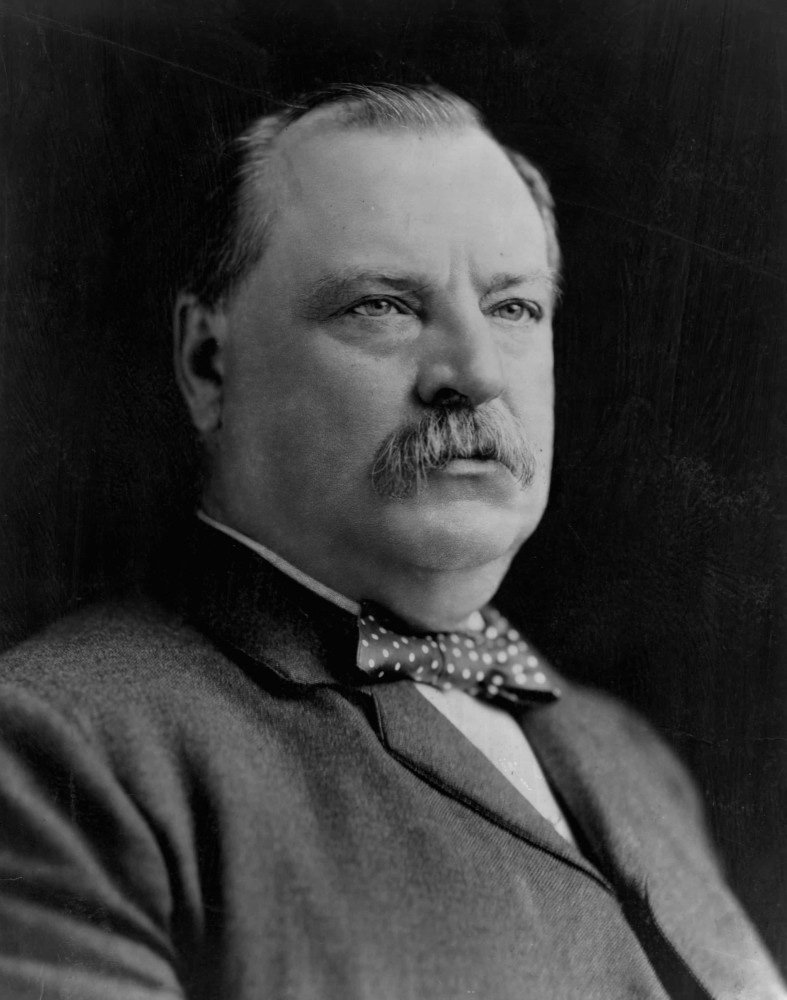
Grover Cleveland: Reform, Crisis and the Only Non‑Consecutive Presidency
Stephen Grover Cleveland served as the 22nd and 24th president of the United States—the only person in American history to hold two non‑consecutive presidential terms: March 4, 1885–March 4, 1889, and March 4, 1893–March 4, 1897. He governed as a Democrat whose public reputation rested on personal integrity, opposition to patronage and a conservative approach to fiscal policy. trumpwhitehouse.archives.gov
Elections and political context
Cleveland won the 1884 election by narrowly defeating Republican James G. Blaine, aided in part by reform‑minded Republicans (the “Mugwumps”) who objected to Blaine’s record. The campaign featured intense personal attacks and close returns in key states. encyclopedia.com
In 1888 Cleveland won a plurality of the national popular vote but lost the Electoral College to Republican Benjamin Harrison, a result that underscored the period’s regional political cleavages and the continuing centrality of tariff policy to national politics. Cleveland returned to defeat Harrison in 1892, when he again carried a divided electorate that included a significant third‑party showing from the Populist movement. scholarworks.iu.edu
Vice presidents and leading Cabinet figures
Cleveland’s first-term vice president was Thomas A. Hendricks (died November 25, 1885); the office remained vacant after Hendricks’s death. In Cleveland’s second term Adlai E. Stevenson I served as vice president (1893–1897). Among Cabinet officials who shaped policy were Thomas F. Bayard (Secretary of State, 1885–1889), Daniel Manning and Charles S. Fairchild (Secretaries of the Treasury across terms), William C. Whitney (Navy) and, in the second administration, Walter Q. Gresham and Richard Olney at State and John G. Carlisle at Treasury—figures who influenced diplomacy, monetary policy and regulatory responses. millercenter.org
Major domestic legislation and policy
Cleveland signed the Interstate Commerce Act (approved February 4, 1887), landmark federal legislation to regulate railroad practices and establish the Interstate Commerce Commission—an early exercise of federal economic regulation. He also championed civil‑service reform, used the veto frequently (particularly against private pension bills he considered fraudulent), and repeatedly argued for lower protective tariffs. archives.gov
During Cleveland’s second term the economy suffered the Panic of 1893. The administration prioritized maintaining the Treasury’s gold reserves and reversing policies seen as inflating the currency. Cleveland successfully pressed Congress to repeal the silver‑purchase provision of the Sherman Silver Purchase Act; the purchasing clause was removed by statute on November 1, 1893. That decision placed Cleveland firmly on the side of the gold standard and alienated many western and silver‑supporting Democrats. fraser.stlouisfed.org
Labor unrest and national crises
The Panic of 1893 triggered widespread unemployment and business failures. In 1894 the Pullman strike—originating at the Pullman Company in Chicago and expanding into a national railway boycott—prompted Cleveland to authorize federal intervention, including use of a federal injunction and deployment of troops to protect mail delivery and interstate commerce. The decision to enforce the injunction and send troops was controversial at the time and remains a defining episode of Cleveland’s second administration. presidency.ucsb.edu
Foreign affairs: Hawaii, Venezuela and diplomacy
Cleveland opposed the 1893 effort to annex the Hawaiian Islands. Shortly after his 1893 inauguration he withdrew an annexation treaty submitted by the outgoing Harrison administration and ordered an investigation (Commissioner James H. Blount) into U.S. diplomatic and naval roles in the overthrow of Queen Liliʻuokalani; Cleveland publicly urged restoration if the overthrow involved improper American intervention. Congressional and diplomatic responses were mixed; the episode is a central example of late‑19th‑century debates over expansion and imperialism. history.state.gov
In 1895–1896 Cleveland and his Secretary of State Richard Olney pressed Great Britain to arbitrate a long‑running boundary dispute between British Guiana and Venezuela and asserted a forceful interpretation of the Monroe Doctrine in diplomatic correspondence. That stance helped produce arbitration rather than armed conflict and signaled a more assertive American posture in the hemisphere. gutenberg.org
Controversies presented neutrally
Cleveland’s presidency was marked by recurrent controversies. During the 1884 campaign opponents publicized a personal paternity scandal from his years as a lawyer; Cleveland responded candidly and the episode did not prevent his election. As president he used vetoes and executive power in ways critics labeled obstructionist or excessively conservative—especially when he vetoed private pension bills and resisted expansive federal relief during economic distress. His 1894 decision to use federal authority against strike activity drew sustained critique from labor advocates. In foreign affairs his opposition to Hawaiian annexation and forceful diplomacy over Venezuela were praised by some as principled and criticized by others as selective. These tensions reflect competing democratic, legal and regional claims of the era. encyclopedia.com
Historical legacy
Historians view Cleveland as a complex figure: a reformer who fought patronage and sought clean government but also a fiscal conservative whose commitment to the gold standard and limited federal intervention alienated parts of his party. His use of executive independence—frequent vetoes, strong personnel control and principled stands on tariff and monetary policy—left an imprint on the evolving powers of the presidency in the late 19th century. Cleveland’s reputation has fluctuated with changing scholarly priorities, but his role in creating regulatory precedents (the ICC), defending stable public credit, and shaping the nation’s diplomatic posture are widely acknowledged. millercenter.org
Sources
- The White House (archived): Grover Cleveland
- Miller Center — Grover Cleveland: Administration and biographies
- National Archives — Interstate Commerce Act (1887)
- Library of Congress — Presidential Election of 1892: Resource Guide
- The American Presidency Project — Grover Cleveland, second‑term timeline
- FRASER (Federal Reserve Archival System for Economic Research) — historical monetary documents
- White House Historical Association — Frances Cleveland and the White House
- Encyclopedia.com — Grover Cleveland biography and context
- Library of Congress — Foreign Relations and Blount Report materials (Hawaiian affairs)
Smart shopping starts here.
If you enjoyed this article, explore our curated products designed for everyday living.
📱 Download the Dralys App
🛍️ Shop now: www.DralysStore.com