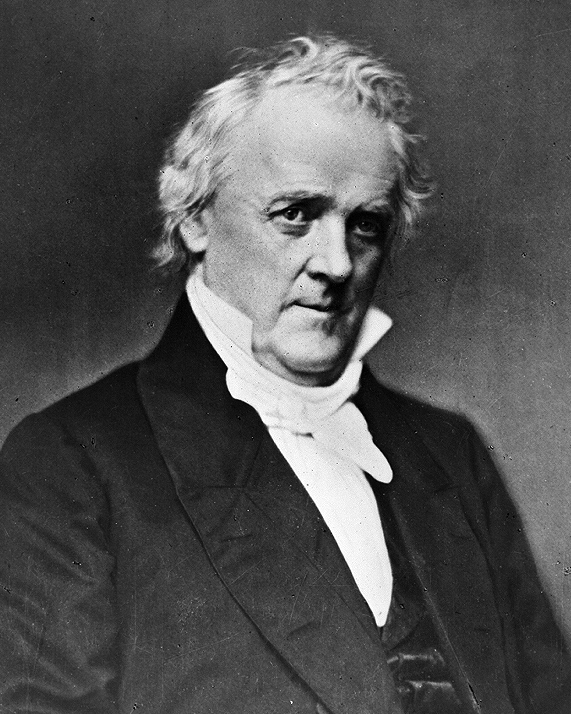
Overview
James Buchanan served as the 15th president of the United States from March 4, 1857, to March 4, 1861. He was a member of the Democratic Party and carried John C. Breckinridge as his vice president. Buchanan won the 1856 election over Republican John C. Frémont and former president Millard Fillmore (American/Know Nothing), taking 174 electoral votes to Frémont’s 114 and Fillmore’s 8. His presidency unfolded amid accelerating sectional tensions, economic crisis, and disputed questions about federal power and slavery. presidency.ucsb.edu
Election and Inauguration
Buchanan entered the White House with limited northern support: he won only a handful of northern states and less than a majority of the popular vote, about 45.3 percent, reflecting the nation’s sectional fracture. His campaign benefited from a split opposition in the North between emerging Republicans and nativist elements backing Fillmore. presidency.ucsb.edu
Key Cabinet Figures
Buchanan’s cabinet included several influential—and sometimes controversial—figures: Lewis Cass (Secretary of State, 1857–1860) and Jeremiah S. Black (Attorney General, 1857–1860; later Secretary of State, 1860–1861); Howell Cobb (Secretary of the Treasury, 1857–1860); John B. Floyd (Secretary of War, 1857–1860); Isaac Toucey (Secretary of the Navy, 1857–1861); and Jacob Thompson (Interior, 1857–1861). Several appointees came from or sympathized with the South, which complicated administration unity as secession loomed. millercenter.org
Major Domestic Issues
Kansas and the Lecompton Constitution: Kansas remained the epicenter of sectional conflict. After the Supreme Court’s Dred Scott decision in March 1857, Buchanan urged Congress to accept the proslavery Lecompton Constitution for Kansas—an action that split his party and provoked strong opposition from Senator Stephen A. Douglas and many Northern Democrats. The Lecompton controversy damaged the administration’s credibility and deepened sectional mistrust. millercenter.org
Panic of 1857 and economic policy: The Panic of 1857 triggered a sharp economic downturn early in Buchanan’s term. The crisis intensified political conflict over tariffs, banking and land policy. Buchanan proposed limited federal measures but generally resisted large-scale federal intervention; he also vetoed legislation favored by some western and northern interests, most notably exercising a veto on the Homestead bill in 1860. loc.gov
Foreign Affairs
Expansion-minded diplomacy remained on the agenda. Buchanan had been involved, earlier in his career as a diplomat, with the Ostend Manifesto episode (1854), which recommended acquiring Cuba—an episode that critics used to portray him as aligned with Southern expansionism. As president he continued to press issues of American transit and influence in Central America and the Caribbean, arguing at times for congressional authorization to protect U.S. citizens and transit routes abroad. loc.gov
National Crises and Controversies
Dred Scott and sectional reaction: The Supreme Court’s Dred Scott decision (March 6, 1857) held that people of African descent could not be U.S. citizens and that Congress lacked authority to bar slavery in the territories. The ruling and Buchanan’s subsequent political alignment with its implications inflamed Northern opinion and widened the rift within the Democratic Party and the nation. archives.gov
Utah Expedition (the “Utah War”): In 1857 Buchanan ordered a federal expedition to replace Utah’s Mormon territorial governor, Brigham Young, after reports (later disputed) of defiance of federal authority. The deployment produced a year-long standoff known as the Utah War (1857–1858); while it ended without large-scale pitched battles, it exemplified Buchanan’s readiness to use force to assert federal appointments and authority outside the slavery controversy. historytogo.utah.gov
Cabinet fissures and the approach of secession: By late 1860 cabinet unity had collapsed. Secretary of War John B. Floyd—criticized for actions viewed as favoring the South—resigned in December 1860 amid charges and suspicion that government arms and supplies had been handled in ways that advantaged Southern interests; Floyd later took a Confederate commission. These personnel shifts highlighted how sectional loyalty fractured federal administration in the critical months after the 1860 election. millercenter.org
Important Laws and Presidential Actions
Buchanan presided while Congress considered several consequential measures. He vetoed the Homestead bill in June 1860 on constitutional and fiscal grounds; the Homestead policy was later enacted in modified form under Abraham Lincoln in 1862. Buchanan also sought congressional measures to address foreign-relations questions and to secure federal control over territories, but his legislative record was overshadowed by sectional crises. visitthecapitol.gov
Major Controversies, Presented Neutrally
Historians have debated Buchanan’s motives and competence. Supporters argue he sought to honor constitutional limits and avoid civil war by urging Congressional solutions; critics contend his deference to proslavery interests, mishandling of Kansas, and failure to prepare the federal government to preserve the Union constituted decisive errors. In practical effect, Buchanan’s balancing choices made compromise less likely and left the incoming Lincoln administration with a fractured Union and scattered federal forces. millercenter.org
Historical Legacy
Buchanan’s presidency is widely judged by scholars to be among the least effective in U.S. history because it preceded and failed to avert the Civil War. Scholarly surveys and historical assessments consistently place him near the bottom of presidential rankings; that judgment rests primarily on his handling of slavery’s expansion, party division, and the secession crisis. At the same time, primary sources show he believed secession was unconstitutional while also arguing that the executive branch lacked authority unilaterally to coerce states, a constitutional interpretation that shaped his limited actions in late 1860 and early 1861. sri.siena.edu
Conclusion
James Buchanan governed at a moment when institutional norms, partisan breakdown and sectional polarization made leadership extraordinarily difficult. His administration’s decisions on Kansas, the federal response to unrest, economic choices and appointments are central to assessments of his presidency. Whether judged as legal restraint or political failure, Buchanan’s term is inseparable from the cascade of events that ended in secession and war. millercenter.org
Sources
- Miller Center — James Buchanan: Administration
- White House Historical Association — James Buchanan
- The American Presidency Project — 1856 election results
- Library of Congress — Ostend Manifesto material
- Miller Center — James Buchanan: Domestic Affairs
- The American Presidency Project — Selected presidential messages
- U.S. Capitol Visitor Center — Homestead Act (1860) artifact summary
- Utah State History — The Utah War (1857–1858)
- National Archives — Dred Scott and related court records
- Miller Center — John B. Floyd (Secretary of War)
- Siena Research Institute — Presidential expert rankings (2022)
Smart shopping starts here.
If you enjoyed this article, explore our curated products designed for everyday living.
📱 Download the Dralys App
🛍️ Shop now: www.DralysStore.com