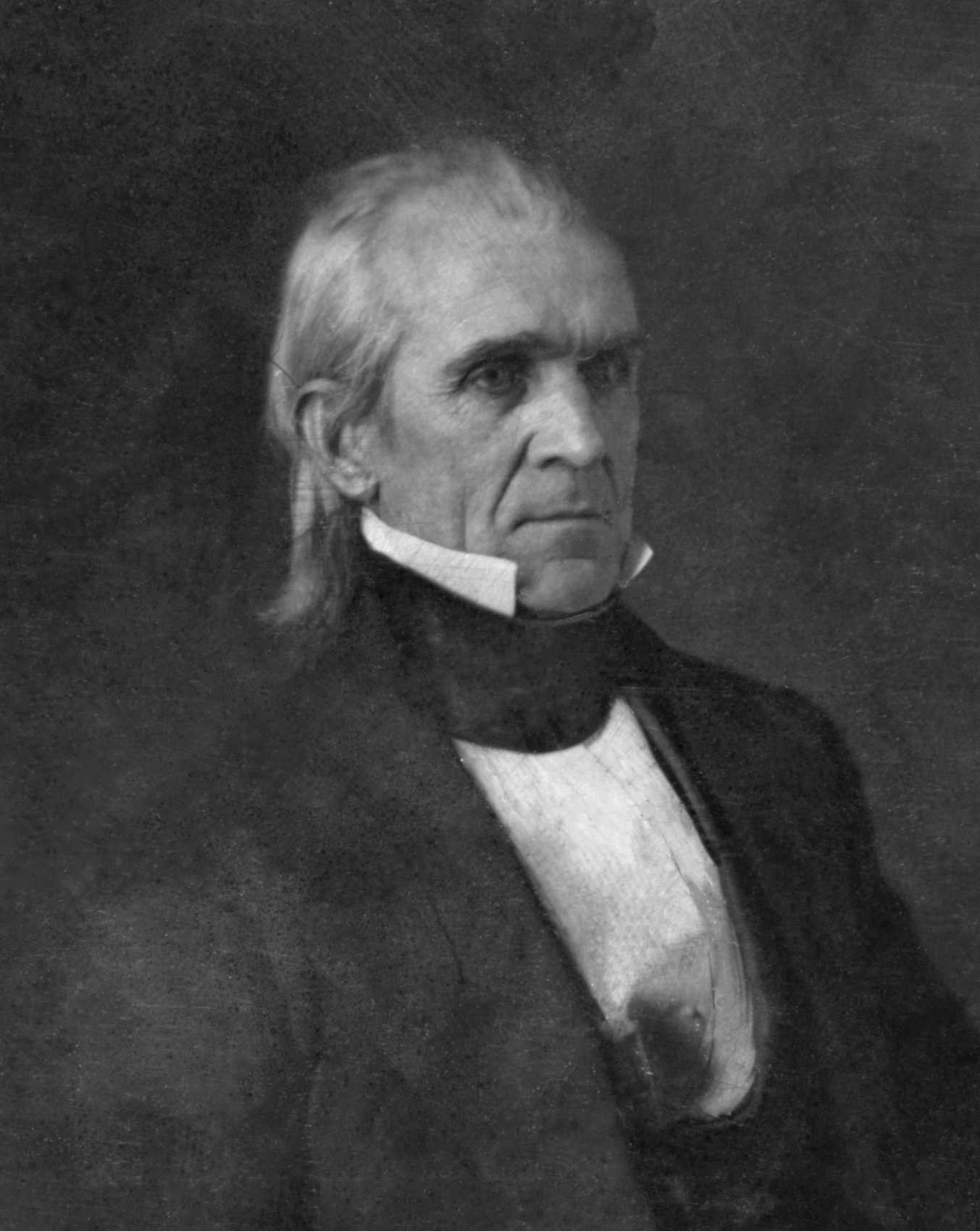
Overview
James Knox Polk served as the 11th President of the United States from March 4, 1845, to March 4, 1849. He was a member of the Democratic Party and served with Vice President George M. Dallas. Polk pledged to serve only one term and left office after four years; he died a few months after leaving the presidency. history.house.gov
Election and political background
Polk was a protégé of Andrew Jackson and emerged in 1844 as the Democratic Party’s compromise “dark horse” nominee after the front-runner Martin Van Buren faltered over Texas annexation. He defeated Whig nominee Henry Clay in a close contest that was affected by third‑party voting; Polk carried the Electoral College decisively while winning the popular vote narrowly. His campaign emphasized territorial expansion—particularly annexation of Texas and claims in the West—under the language of “Manifest Destiny.” guides.loc.gov
Key members of the Cabinet
Polk assembled a Cabinet that combined party allies and experienced officials. Notable figures included James Buchanan as Secretary of State, Robert J. Walker as Secretary of the Treasury, William L. Marcy (Secretary of War), George Bancroft and later John Y. Mason at the Navy Department, Cave Johnson as Postmaster General, and John Y. Mason as Attorney General at intervals. These officials managed the administration’s fiscal, military, and diplomatic efforts. govinfo.gov
Major domestic policies and laws
Polk set a short list of legislative priorities and largely achieved them. His administration won passage of the Tariff of 1846 (the “Walker Tariff”), championed by Treasury Secretary Robert J. Walker; that law substantially reduced tariff rates and moved U.S. policy toward lower duties. Polk also worked to restore an independent Treasury system for federal funds, a fiscal arrangement that removed government deposits from private banks and reestablished Treasury control over receipts and payments. These measures reshaped federal finance and trade policy during his term. home.treasury.gov
Foreign affairs and territorial expansion
Polk’s presidency is most remembered for territorial expansion. The United States formally annexed the Republic of Texas in 1845 during the opening months of his administration; Polk then negotiated a peaceful settlement with Britain over the Columbia River‑Northwest boundary, culminating in the Oregon Treaty of 1846, which set the U.S.–British North American boundary at the 49th parallel. When diplomatic attempts to acquire California and New Mexico from Mexico failed, Polk’s administration sent U.S. forces to Texas and ultimately to war with Mexico (1846–1848). The conflict ended with the Treaty of Guadalupe Hidalgo (signed February 2, 1848), under which Mexico ceded large territories—present‑day California, Nevada, Utah, and parts of several other modern states—to the United States. These foreign‑policy results fulfilled much of Polk’s expansionist agenda. history.state.gov
National crises and controversies
Polk’s expansionist program provoked intense political debate and controversy. The Mexican‑American War raised questions about executive power, the provocation and justification for war, and the human costs of military conquest. At home, the new territory acquired from Mexico provoked immediate and sharp conflict over whether slavery would be allowed to expand into those lands—an issue dramatized by the 1846 Wilmot Proviso, which would have barred slavery from territory acquired from Mexico and helped foreshadow sectional conflict that led to the Civil War. The administration also faced partisan criticism that territorial gains were intended to extend the power of the slaveholding South. The so‑called slogan “54°40′ or fight,” linked to the Oregon boundary dispute, became a rallying expansionist phrase though historians note its campaign origins and later use were more complex than the popular slogan suggested. prod.millercenter.org
Important laws and executive actions
Among specific measures enacted or carried out by Polk’s administration were the Tariff of 1846 (Walker Tariff) and congressional passage and presidential support for legislation reestablishing an independent treasury system in 1846. Polk also acted to secure territorial governments and to transmit the Treaty of Guadalupe Hidalgo to Congress for ratification and implementation. Under his direction, the executive branch pursued settlement and administration plans for newly acquired lands. home.treasury.gov
Assessment and historical legacy
Historians generally credit Polk with achieving the concrete goals he set at the start of his term: territorial expansion to the Pacific, lower tariffs, reformed federal fiscal arrangements, and effective executive management of a focused program. At the same time, his presidency is judged controversial because the Mexican‑American War and the acquisition of new territory intensified sectional conflict over slavery and raised persistent moral and legal questions about war, conquest, and treatment of people in ceded lands. Polk also expanded the scope and assertiveness of the presidency, particularly in foreign policy and wartime decision‑making. Scholars often rank him as an effective and consequential president who achieved much of his program—but whose actions accelerated sectional tensions that shaped the nation’s subsequent course. millercenter.org
After the presidency
Polk left office in March 1849 after keeping his promise to serve only one term. He returned to Tennessee and died on June 15, 1849—less than four months after leaving Washington—making him one of the presidents who died shortly after their service concluded. history.house.gov
Sources
- National Archives — 1844 Electoral College Results
- National Archives — Treaty of Guadalupe Hidalgo (1848)
- U.S. Department of State, Office of the Historian — Milestones (Annexation, Oregon, Mexican War)
- U.S. Department of the Treasury — Robert J. Walker (Walker Tariff)
- GovInfo / GPO — Executive Officers and Cabinet listing (Polk administration)
- Library of Congress — Presidential Election of 1844: Resource Guide
- Miller Center, University of Virginia — James K. Polk (biography and analysis)
Smart shopping starts here.
If you enjoyed this article, explore our curated products designed for everyday living.
📱 Download the Dralys App
🛍️ Shop now: www.DralysStore.com