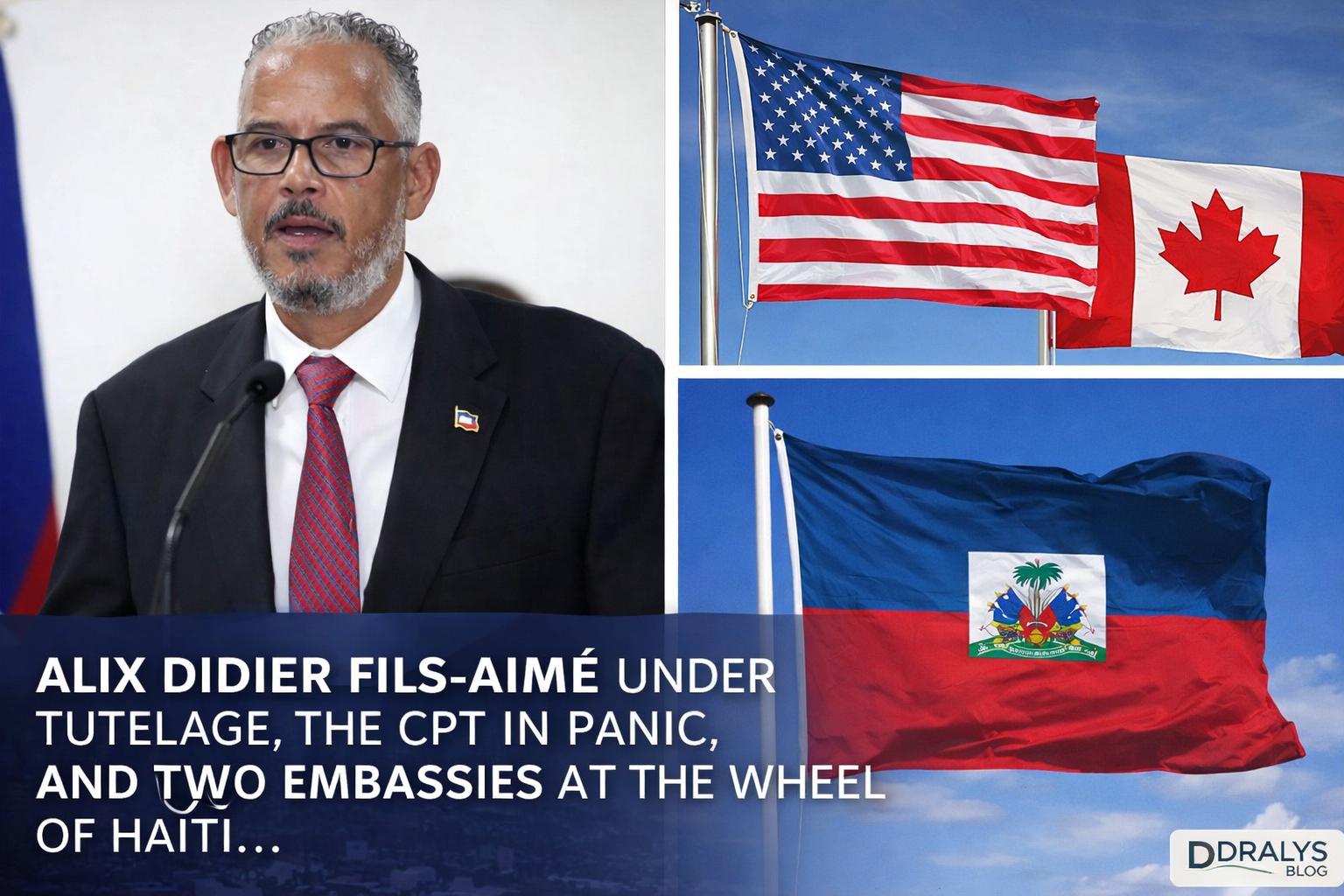
This text is the X-ray of a State under diplomatic anesthesia
This text is the X-ray of a State that is sovereign on paper, but placed under diplomatic anesthesia in reality, to protect a Prime Minister who works above all in the interest of his foreign patrons, while the nine corrupt extras, politically stateless and spineless, of the Transitional Presidential Council (CPT), fight over the key to an invisible prison.
Less than fifteen days before the end of the mandate of the nine presidential advisers, a mandate without vision, without tangible results, and without any dignity, Haiti is not going through a political crisis; it is undergoing a takeover. And as always in disguised protectorates, it is neither the ballot boxes nor the people who decide, but diplomatic notes drafted in Washington and reinforced, echoed, and amplified in Ottawa.
A REGIME PANIC UNDER FOREIGN PROTECTION
The open conflict of recent days between the Prime Minister’s Office, led by Alix Didier FILS-AIMÉ, and the Transitional Presidential Council (CPT) is not an institutional dispute. It is a regime panic, a survival struggle between two equally illegitimate entities, but unequally protected.
On one side stands a de facto Prime Minister without popular support or an electoral mandate, yet sheltered under the North American umbrella. On the other side are nine members of the CPT, five of whom are in a hurry to remove him before Saturday, February 7, 2026, not out of concern for the national interest, but because the judicial ground beneath their feet is dangerously cracking.
WHEN CANADA SPEAKS, THE CPT FALLS SILENT; WHEN WASHINGTON THREATENS, THE CPT RETREATS

The scene is highly revealing and theatrical, above all, a real political reality show. Hardly had the CPT initiated the revocation resolution when Canada publicly intervened, warning that such a decision “could weaken Haiti’s stability and security.”
But this time, the United States did not settle for masked diplomatic silence. It spoke loudly, very loudly. In an unambiguous public warning, Washington explicitly cautioned the CPT, recalling the “political, security, and institutional consequences” of a revocation attempt deemed “irresponsible.”
The message is clear, brutal, and imperial: Prime Minister Alix Didier FILS-AIMÉ must not fall now, especially not without the approval of the patrons, nor against the will of the foreign embassies in Haiti.
Ottawa, far from moderating the situation, reinforced the American line, positioning itself as a political co-guarantor of the Prime Minister, turning the Prime Minister’s Office into a diplomatically protected zone.
According to observers, since when has Haiti’s stability depended on a single man? Since when has the departure of a Prime Minister in a country that has consumed them to excess suddenly become a significant geopolitical risk? The answer is simple and obvious: it is not Haiti that is being protected, but a system.
THE VIENNA CONVENTION TRAMPLED, DIGNITY CRUSHED
American and Canadian interference no longer even falls within the realm of classic diplomacy. It verges on a blatant violation of the Vienna Convention when embassies dictate, arbitrate, warn, and steer.
And in the face of this? Haitian leaders who are politically stateless and spineless, more concerned about their visas and families settled in Montreal or Florida than about the national sovereignty they invoke on television.
A CPT FABRICATED AND CONFISCATED
It must be recalled that a truth many pretend to forget is that the CPT was not born of a Haitian choice, but of an international operation in April 2024, following the sidelining of former Prime Minister Ariel HENRY, with CARICOM as a façade, the United States as the chief conductor, and Canada as the vigilant co-manager.
In other words, the CPT is an organ under tutelage, the Prime Minister a manager under condition, and the Haitian people remain offstage, reduced to enduring.
Today, the system is turning against itself: the guards want to overthrow the supervisor, but the prison’s owners oppose it.
JUSTICE, BNC, AND DEEP FEAR
Behind the revocation resolution lies less politics than judicial terror. The files linked to the financial scandals of the National Credit Bank (BNC) and the names already cited in the public sphere, Smith AUGUSTIN, Louis Gérald GILLES, and Emmanuel VERTILAIRE, haunt the corridors of the CPT.
In this context, the Director General of the Anti-Corruption Unit (ULCC), Hans L. JOSEPH, becomes a threat. And Alix Didier FILS-AIMÉ, whether one likes it or not, is a lock. This is therefore not a battle for Haiti, but a preventive war against Haitian justice.
This CPT looks less like a collegiate presidency than a meeting of tenants fearing eviction.
It must be recalled that Prime Minister Alix Didier FILS-AIMÉ does not work for the Haitian people. He works in his North American patrons’ interests. Nor does the CPT, as one is supported against the popular will, and the others want to govern without accountability. In both cases, Haiti is absent and sidelined.
When the United States and Canada defend a Haitian leader, it is never for Haiti. It is for their interests, their agreements, and their regional balances.
The stability they protect in Haiti is not that of the popular neighborhoods, but that of their clandestine arrangements.
Ultimately, it is time for Haitian politics to free itself from foreign life support, and for dignified leaders of character to emerge who can govern freely, without waiting to know who will be authorized to obey.
Haiti, that great Nation which once made modern colonial empires tremble, is still waiting for its voice to be returned
Amos CINCIR
Servant of the Empire of Hayti-Africa
Ambassador of the Kingdom
Smart shopping starts here.
If you enjoyed this article, explore our curated products designed for everyday living.
📱 Download the Dralys App
🛍️ Shop now: www.DralysStore.com