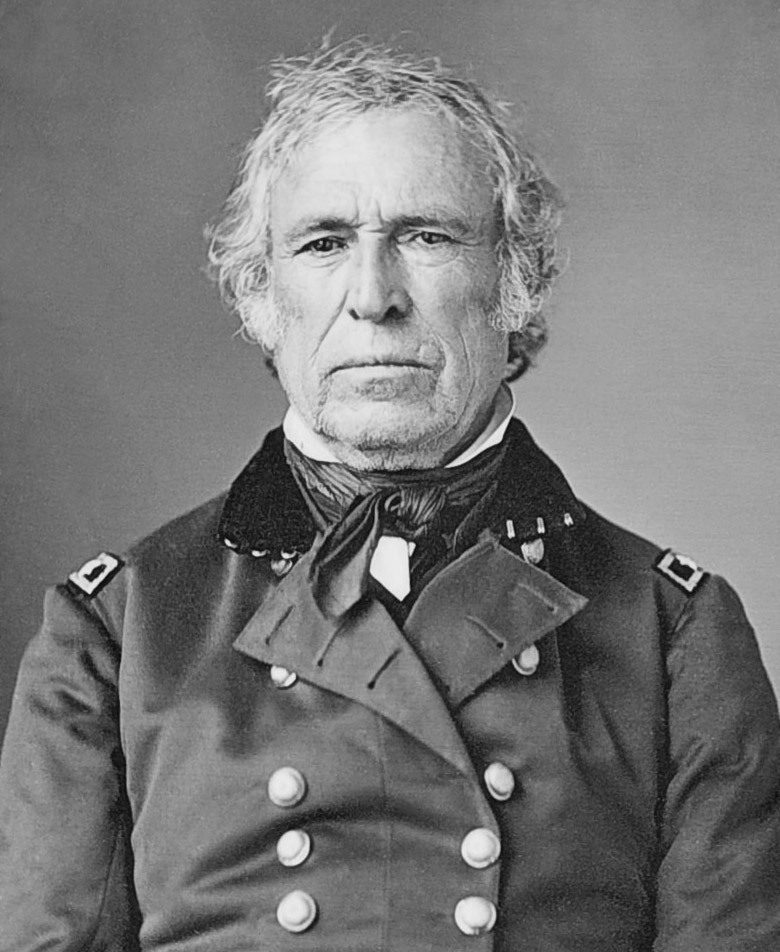
Zachary Taylor: The Soldier Who Became President and Died Amid a Nation’s Crisis
Zachary Taylor served as the 12th president of the United States from March 5, 1849, until his death on July 9, 1850. A Whig and a lifelong military officer with no prior elected office, Taylor’s vice president was Millard Fillmore. His presidency lasted sixteen months and ended abruptly when he died in office; Vice President Fillmore succeeded him. presidency.ucsb.edu
From Mexican‑War Hero to Whig Nominee
Taylor rose to national prominence as a general in the Mexican‑American War (1846–1848). His battlefield successes made him a Whig favorite in 1848: the party nominated him over established politicians, and he won the November 1848 election in a three‑way race against Democrat Lewis Cass and former President Martin Van Buren, the Free Soil candidate. Taylor carried enough key states to secure the Electoral College victory. pbs.org
Governing Team and Style
As a non‑politician, Taylor filled his cabinet with experienced party figures and sectional balances. His principal appointees included Secretary of State John M. Clayton; Secretary of the Treasury William M. Meredith; Secretary of the Interior Thomas Ewing; Attorney General Reverdy Johnson; Secretary of the Navy William B. Preston; Secretary of War George W. Crawford; Postmaster General Jacob Collamer; and First Lady Margaret Taylor was a visible presence at the White House. Taylor’s management style remained shaped by his military background: decisive, hierarchical, and focused on immediate problems rather than long legislative projects. millercenter.org
Domestic Challenges: California, Territories, and Slavery
Taylor’s administration confronted the political consequences of territorial gains from the Mexican War and the California gold rush. California and parts of the Mexican Cession moved quickly to draft constitutions and seek admission to the Union; many settlers in those new communities framed constitutions that prohibited slavery. Taylor urged the people of these territories to form state constitutions and petitions for admission rather than wait for protracted territorial organization in Congress — a stance that alarmed many Southern leaders because California’s admission as a free state would alter the Senate balance. Taylor’s position and the sectional reaction helped precipitate the crisis that produced the Compromise of 1850; Taylor opposed some elements of Henry Clay’s omnibus compromise and resisted legislative packages he believed unduly rewarded sectional pressure. He died before Congress completed the measures; his successor, Millard Fillmore, supported the compromise that Congress ultimately passed. presidency.ucsb.edu
Major Foreign Policy Action: The Clayton‑Bulwer Agreement
On the international front the administration’s most durable achievement was the negotiation and proclamation of the Clayton‑Bulwer agreement with Britain on questions surrounding a possible Central American canal and Anglo‑American influence in Central America. Secretary of State John M. Clayton led the diplomatic work that produced the treaty text; it represented a step toward managing rival U.S. and British ambitions in the hemisphere. Taylor proclaimed the convention and the administration transmitted it to the Senate for consideration. history.state.gov
National Crises and Law Enforcement
Taylor’s presidency coincided with several crises that tested executive authority. The California gold rush produced huge migration and governance problems for newly settled districts; Taylor used military detachments and federal attention to maintain order while urging settlers to organize civil governments. He also confronted and publicly opposed unauthorized private military expeditions (“filibustering”) directed at Caribbean and Central American targets, a phenomenon that inflamed sectional politics and complicated relations with European powers. At home, mounting sectional rhetoric and talk of Southern conventions or disunion heightened the sense that federal leadership must preserve the Union while balancing competing regional demands. loc.gov
Controversies: Slavery, Expectations, and the Galphin Question
Taylor was a Southern slaveholder by background — he owned plantations and enslaved people in the Lower Mississippi region — yet his political posture on slavery’s expansion was not reliably pro‑slavery expansion in the way many contemporaries expected. That ambiguity irritated southern expansionists who had supported him as a slaveholder, while northern critics saw him as insufficiently committed to restricting slavery. His administration also faced at least one public scandal over claims of improper payments related to post‑war claims (sometimes discussed under the name of the Galphin matter and related controversies); those disputes were public and politically sensitive, though not of the scale of the territorial and sectional struggles that dominated his term. edspace.american.edu
Death in Office and Later Forensic Study
On July 9, 1850, Zachary Taylor died suddenly after a brief illness while at the White House. Contemporary reports diagnosed acute gastroenteritis (then often called “cholera morbus”). Over a century later, in 1991, Taylor’s remains were exhumed for forensic testing amid allegations of arsenic poisoning. Analyses, including neutron‑activation testing performed on samples sent to Oak Ridge, found only trace arsenic levels far below those that would indicate lethal poisoning; the Kentucky medical examiner reported that results were consistent with natural gastrointestinal disease and medical treatments of the period. The 1991 findings remain the most direct scientific assessment of long‑standing questions about his death. washingtonpost.com
Short Term Impact and Historical Legacy
Taylor’s short presidency had outsized historical consequences because it arrived at the nadir of antebellum sectional tension and ended just as Congress was negotiating a major national settlement. His insistence that territories move toward constitutions and statehood reflected a political effort to remove debate from Congress and limit sectional bargaining — an approach that helped precipitate the compromise debates of 1850 even as he resisted Clay’s omnibus plan. His death shifted executive support to Fillmore, whose administration and cabinet backed the legislative package that temporarily eased sectional friction.
Over time historians have viewed Taylor as an atypical president: a prominent soldier with little political experience whose choices were shaped by temperament, personal networks, and the urgent regional conflicts of his moment. Scholars note both the limitations of a brief term and the symbolic importance of a military leader confronting constitutional and political strains that ultimately led to the Civil War generation. millercenter.org
Sources
- The American Presidency Project — Zachary Taylor
- National Archives — Electoral College, 1848
- Miller Center, University of Virginia — Zachary Taylor: Administration
- Library of Congress — Zachary Taylor Papers: Timeline
- Office of the Historian, U.S. Department of State — John M. Clayton
- The Washington Post — “No Evidence of Poisoning Unearthed in Taylor’s Case” (1991)
- Oak Ridge National Laboratory — “President Zachary Taylor and the Laboratory”
Smart shopping starts here.
If you enjoyed this article, explore our curated products designed for everyday living.
📱 Download the Dralys App
🛍️ Shop now: www.DralysStore.com