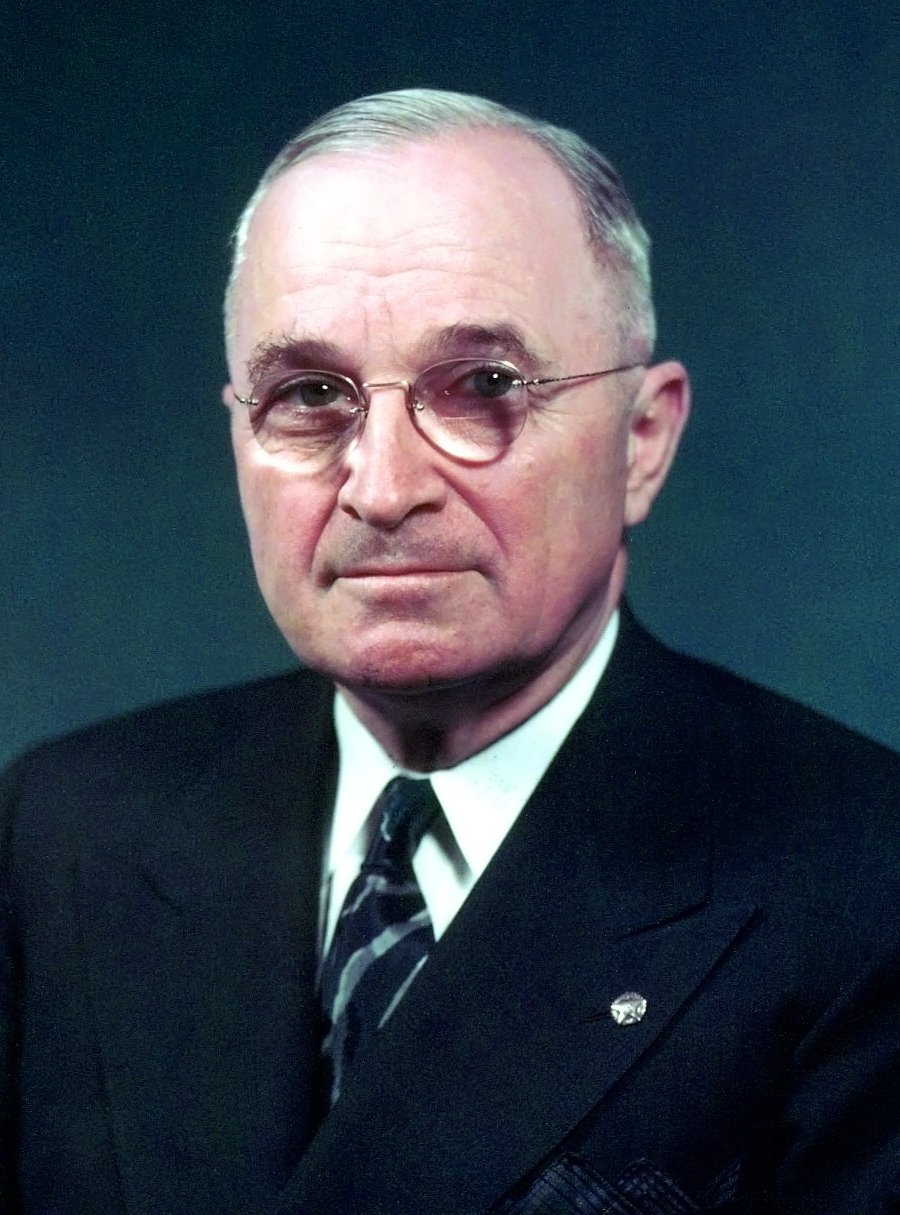
Harry S. Truman: Decisions, Crisis and the Making of the Cold War Presidency
Harry S. Truman, a Democrat from Missouri, served as the 33rd president of the United States from April 12, 1945, when he succeeded Franklin D. Roosevelt, until January 20, 1953. He completed Roosevelt’s fourth term and won a full term of his own in 1948. The vice presidency was vacant from Truman’s accession in April 1945 until his elected running mate, Alben W. Barkley, took office on January 20, 1949. presidency.ucsb.edu
Political rise and the 1948 election
Truman became vicepresident in January 1945 and assumed the presidency on April 12, 1945, following Roosevelt’s death. He was nominated by the Democratic Party in 1948 and defeated Republican Thomas E. Dewey in a widely remembered upset, winning 303 electoral votes to Dewey’s 189 and about 49.5% of the popular vote. The 1948 campaign took place amid deep domestic divisions—Southern Democrats walked out over civil‑rights proposals, producing Strom Thurmond’s Dixiecrat candidacy—and a skeptical press and pollsters who had largely forecast Dewey’s victory. trumanlibrary.gov
Key Cabinet figures and advisers
Truman’s foreign policy team included three successive secretaries of state who shaped the early Cold War: James F. Byrnes (1945–1947), General George C. Marshall (1947–1949) and Dean Acheson (1949–1953). The post‑war defense reorganization made James V. Forrestal the first Secretary of Defense (1947–1949); Louis A. Johnson and later Robert A. Lovett also served in the late 1940s and early 1950s. Attorney General Tom C. Clark and Treasury Secretary John W. Snyder were other recurring Cabinet presences. Truman relied heavily on the Truman Library’s “inner circle” of advisers and on a group of experienced foreign‑policy figures often called the “Wise Men.” trumanlibrary.gov
Major domestic policies and laws
Truman’s domestic agenda—labeled the “Fair Deal” in his January 1949 State of the Union—sought to extend New Deal programs with measures for full employment, housing, health insurance and civil rights. Congress approved only parts of the program: the Housing Act of 1949 (urban renewal and public‑housing targets), increases in the minimum wage, and notable Social Security expansions in 1950. Other Fair Deal goals—national health insurance, repeal of Taft‑Hartley and large new welfare programs—were blocked by a conservative coalition in Congress. prod.millercenter.org
Earlier in his presidency Truman signed the Employment Act of 1946, which declared national policy in favor of maximum employment and created the Council of Economic Advisers to advise the White House on economic policy. The postwar economy, strikes and inflation made economic management a central concern for Truman’s team. fraser.stlouisfed.org
National security, institutions and foreign policy
Truman’s foreign‑policy record shaped the early Cold War. He articulated the Truman Doctrine in 1947—pledging support for states resisting subversion—and oversaw implementation of the Marshall Plan (Economic Cooperation Act of 1948) to rebuild Western Europe. Truman signed the Marshall Plan into law in April 1948 and backed the Berlin Airlift (1948–49) when the Soviet Union blockaded access to West Berlin. In 1949 the United States and Western allies created NATO as a collective‑defense pact. These initiatives were accompanied by institutional changes: the National Security Act of 1947 reorganized the U.S. military framework, created the National Security Council and authorized a Central Intelligence Agency. archives.gov
On May 14, 1948, Truman recognized the new State of Israel—one of the administration’s most consequential and controversial diplomatic choices—acting just minutes after the declaration of independence. That decision reflected humanitarian, domestic political and strategic considerations and differed from the cautious advice of some State Department officials. archives.gov
The Korean War, civil‑military authority and crises
When North Korea invaded South Korea on June 25, 1950, Truman ordered U.S. forces into a United Nations–backed police action. The Korean War dominated Truman’s last term, driving defense mobilization and shaping foreign‑policy priorities. The war also precipitated one of Truman’s most disputed decisions: the relief of General Douglas MacArthur in April 1951 after MacArthur repeatedly challenged administration strategy and publically criticized civilian policy. Truman framed the removal as an assertion of civilian control of the military. prod.millercenter.org
Domestic crises raised constitutional questions about executive power. In April 1952, facing a threatened national steel strike during the Korean War, Truman ordered seizure of the steel mills to keep defense production running. The Supreme Court in Youngstown Sheet & Tube Co. v. Sawyer (1952) rejected the president’s unilateral seizure, limiting wartime claims of domestic authority and shaping later doctrine on separation of powers. law.cornell.edu
Civil rights and internal security
On civil rights, Truman took consequential executive steps: he established a presidential committee on civil rights and issued Executive Order 9981 on July 26, 1948, to desegregate the armed forces—an early, binding federal action that helped integrate military service by the end of the Korean War. Simultaneously, in 1947 he signed Executive Order 9835 establishing a federal loyalty‑screening program for government employees, a response to postwar fears about Soviet espionage that critics say helped feed Cold War civil‑liberties tensions. Those two strands—assertive civil‑rights steps and aggressive loyalty measures—reflect the complex domestic balance of Truman’s era. archives.gov
Controversies and criticism
Truman’s presidency drew sharp criticism from different quarters. Conservatives blamed his domestic agenda and perceived administrative patronage; liberals faulted him when Congress failed to enact more of the Fair Deal. Anti‑communist opponents accused the administration of being “soft” on Soviet espionage after several spy scandals in the late 1940s. Critics also attacked Truman’s exercise of executive power—especially his steel‑seizure order—while supporters cited his willingness to use authority in crises and to protect U.S. strategy in Korea and Europe. Historians note the tension between Truman’s civil‑rights leadership and his administration’s security measures during the Red Scare. prod.millercenter.org
Historical legacy
Assessments of Truman have grown more favorable over time. He is widely credited with setting the institutional and policy foundations of U.S. Cold War strategy—NATO, the Marshall Plan, the National Security Act—and with taking decisive, often risky steps in moments of crisis. At the same time, debate continues about the limits of presidential power reflected in his domestic interventions and the civil‑liberties costs of anti‑communist policies. Today’s scholarly consensus tends to rank Truman as a consequential president whose practical decisions helped shape the second half of the 20th century. archives.gov
Sources
- Harry S. Truman Presidential Library & Museum
- National Archives — 1948 Electoral College Results
- Miller Center — Truman: Domestic Affairs
- National Archives — Executive Order 9981 (1948)
- CIA / National Security Act materials (1947)
- National Archives — The Marshall Plan
- National Archives — Recognition of Israel (May 14, 1948)
- Legal Information Institute — Youngstown Sheet & Tube Co. v. Sawyer (1952)
- FRASER / St. Louis Fed — Employment Act of 1946 (context)
- HUD / CRS background on the Housing Act of 1949
Smart shopping starts here.
If you enjoyed this article, explore our curated products designed for everyday living.
📱 Download the Dralys App
🛍️ Shop now: www.DralysStore.com